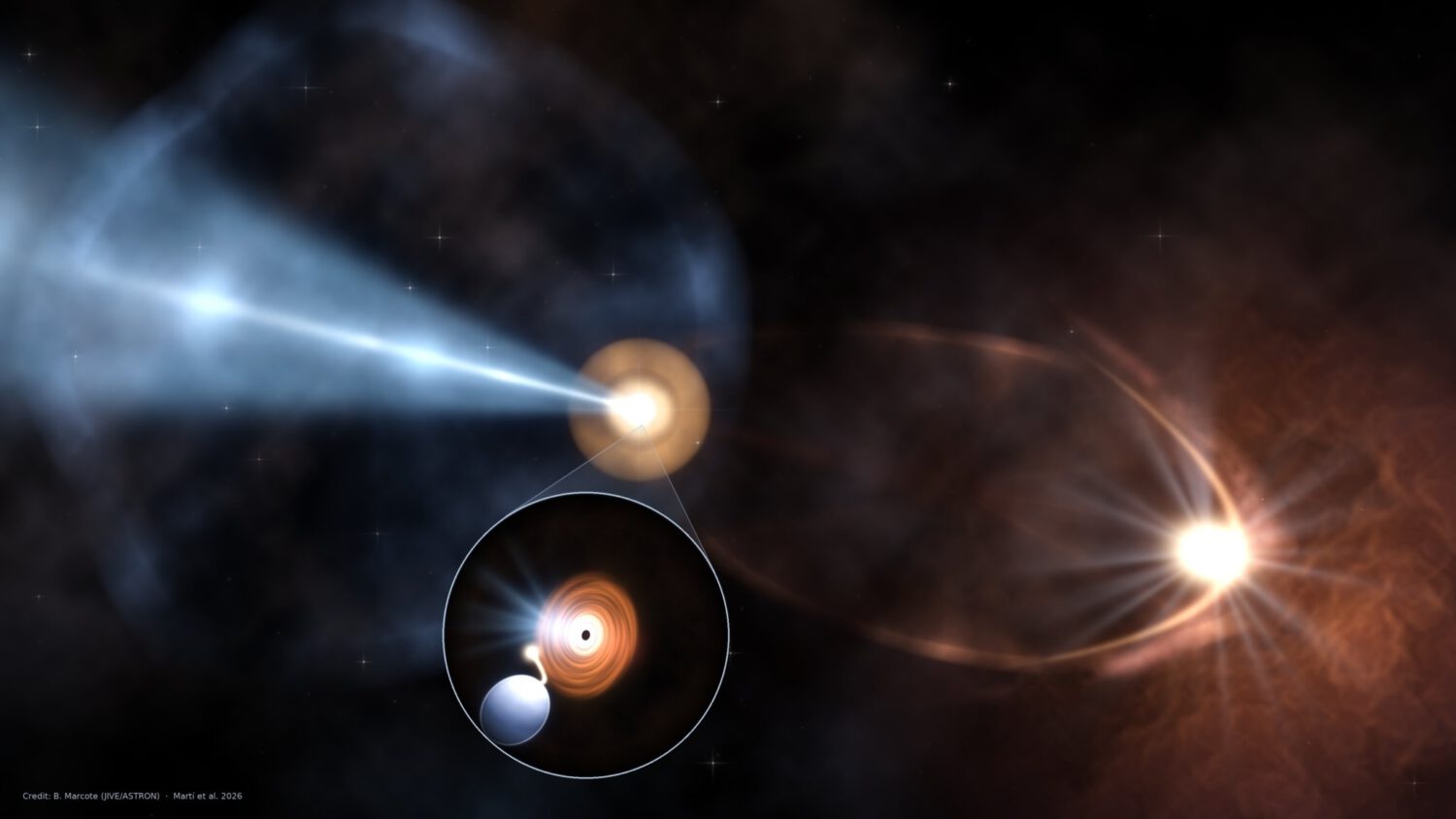
A black hole 12,000 light-years away is firing a jet of plasma almost directly toward Earth. At that distance, no known or expected danger to Earth has been identified by the researchers or the institutions involved.
What astronomers have actually found is rarer and more interesting than a threat. Researchers have identified IRAS 18293-0941 as a compelling candidate for the Milky Way’s first microblazar, a class of object that gives astrophysicists a close-up laboratory for studying some of the most violent physics in the galaxy.
What Astronomers Found
The discovery centers on a binary system whose black hole expels plasma jets at close to three-quarters the speed of light, pointed almost directly toward Earth.
The system pairs a hot, massive star with a black hole that completes a full orbit roughly every 11.38 days. Material drawn from the companion star feeds the black hole, and some of that matter gets expelled outward as opposing jets traveling at approximately three-quarters the speed of light.
Terminology matters here. A microquasar is a stellar-scale version of a quasar, while a microblazar is a microquasar whose jet points toward the observer. That geometry is precisely what makes IRAS 18293-0941 scientifically extraordinary.
Dense interstellar dust hides the system at optical wavelengths. Researchers combined data from the European VLBI Network, MeerKAT in South Africa, the Calar Alto Observatory, and archival Very Large Array records to detect it.
The jet shows collimated, one-sided radio emission consistent with relativistic motion. A small ejection angle completes the observational fingerprint of a blazar-like geometry.
So Should You Actually Worry?
The short answer is no: distance alone removes this object from any realistic threat category.
At 12,000 light-years, the jet presents no realistic hazard to Earth by any current scientific assessment. The hypothetical exists, however: if a comparable relativistic jet were aimed at Earth from a dramatically closer distance, it could raise high-energy radiation exposure and affect biological organisms and electronics. That is a physics thought experiment, not a forecast for this object.
One correction is worth stating directly. Some coverage has used “radioactive goo” as shorthand for the jet material. The jet carries plasma, meaning ionized matter associated with high-energy radiation and particle acceleration. It is not a radioactive substance, and it is not a solid stream on a collision course with the planet.
A Window Into the Galaxy’s Most Extreme Physics
The real significance of this discovery is what it opens up for researchers studying black hole jets, particle acceleration, and the origin of the Milky Way’s most energetic cosmic rays.
Researchers propose that IRAS 18293-0941 could help explain how black holes accelerate particles and how relativistic jets interact with surrounding interstellar gas. The study also explores whether systems like this contribute to the ultra-high-energy cosmic rays that reach Earth’s upper atmosphere from sources that remain unknown.
The study, accepted in Astronomy & Astrophysics, notes a proposed connection between the system and the nearby ultra-high-energy gamma-ray source LHAASO J1831-1007u. That link remains unconfirmed; the researchers describe it as an interpretation, not an established causal relationship.
Some institutional descriptions call IRAS 18293-0941 the first confirmed Galactic microblazar, while the underlying research frames it as a strong candidate. The researchers also note that expected jet variability has not yet been observed, possibly because a dense circumstellar environment is masking it. That open question warrants inclusion in any accurate account of the discovery.
This is not an object to fear. It is a rare alignment of cosmic geometry that gives scientists something genuinely uncommon: a nearby blazar-like system, comparable to distant extragalactic blazars, available for study on a human timescale using instruments already on the ground.